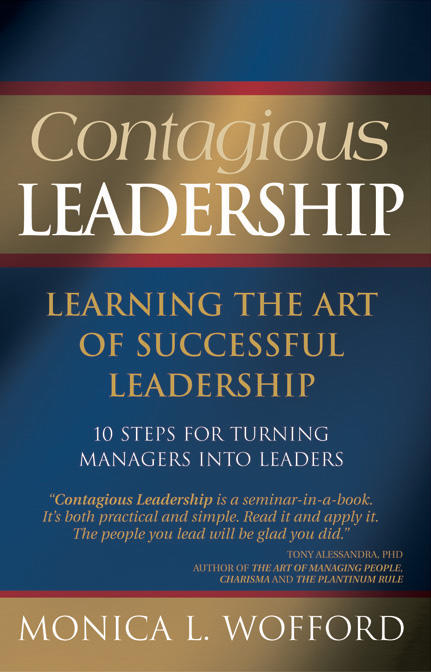
In this month's issue of Lessons in Leadership, learn:
Contagious Leadership lesson:
What is your "PERCEPTIONALITY"?
Contagious Customer Service Lesson:
To be Contagious, Be Aware of Your Customer's Perception
Contagious Confidence Lesson:
What Does Your Audience Perceive About You?
CONTAGIOUS LEADERSHIP LESSON:
WHAT IS YOUR "PERCEPTIONALITY"? (Contagious Leaders know!)
Well, that's a new one! Haven't you always been told that perception is reality? And isn't it? Or is it? Maybe it is just the way YOU see things or the way THEY see things. There aren't multiple realities, at least not for most of us, so what is the difference in interpretation attributed to?
Part of the difference in interpretation is based on our personalities. Not to say that any one of us has one certain personality all day every day - AT ALL. In the same breath, there is a lot of truth to the fact that we gravitate to one personality usually more often than another. Thus, if you don't already know your base level personality type - check out this free assessment and and
then see how your "perceptionality" fits in.
To take your FREE Personality Assessment, click here.
And here I thought I was being all ingenious by coming up with word that seemed so clearly to describe why two people can see the same event or hear the same message and interpret it so very differently: perceptionality. A gentleman named Paul Davis, currently working on his PhD, is exploring the phenomenon he and I both seem to call Perceptionality (though clearly he had the idea first!). Here is how he describes it (in his clinical and scientific research soon to be the topic of a new book):
PERCEPTIONALITY (noun): the manner in which a person perceives reality
Surely Contagious Leaders (For a special report of the The Top 100 Things to do to be a Contagious Leader: Go to http://www.monicawofford.com/special-reports.php) see this every day. One person sees reality in one way, and another perfectly well intentioned individual sees it another way. Yet the fact remains that there is only ONE reality. Could it really be that Suzy sees things one way because of her biases and experience, whereas David sees things completely differently because of his background? The bizarre part is that both parties are looking at the same event and yet both parties walked away with a completely different impression. I am assuming this has happened to you and I believe the key is their personality, mixed with their perception.
Mix their personality with their perception and you get a bona fide "Perceptionality" (http://www.perceptionality.com/) that can cause lot of conflict, heartache, and miscommunication. Contagious Leaders are keenly aware of how inaccurate their perceptions can be. In fact, has this ever happened to you - someone else's perception of the way things "were" got YOU in a heap of trouble? If so, keep reading and learn to avoid those misperceptions as a Contagious Leader.
Personality Type: Black and White Get to the Point Person (Driver)
This person will often see things as clear cut and will also see his or her way as the "right way" and be quite confident about it. This person is often great as a sales person, yet dislikes details. He or she can often tell you the exactly "right" thing to buy or to do.
Frequent misperceptions can include:

~Social chit-chat is a waste of valuable work-time
~Long meetings/phone calls are unproductive
~Too many details drown out the end results
~If you have to think about it, you'll miss out
With this type of personality, anything that is done slowly, with several other people, or done in a haphazard fashion is subject to being taken over by the "black and white" person. Perceptions or often misperceptions, can cause this person to quickly judge others as slow or unproductive unfairly. Give them the meat of the issue and only give them dressing if they ask for it, and they eventually will.
Personality Type: Processor, Gatherer of Information (Analytical)
This person will seek out all the facts diligently and methodically prior to making any hasty decisions. This person is often better able to think on paper and likes to "talk out" a situation with others who will share opinions similar or different than his or her own. Great scientists and academics often share these traits.
 Frequent misinterpretations can include:
~Seeing others' decisions as far too hasty
~There is never enough information to make a clear decisions
~Short meetings are highly unproductive - we have to think about it
~If you aren't asking questions, you must not care about the project
With this type of personality, anything that is done quickly or decided upon in short order, probably was not thorough enough and will not get his or her seal of approval or support. (unless something is on fire) This person's perceptions can often cause him or her to take the quick decision personally and over analyze the lack of desired detail and alternate options. Share with this person as much detail as you can, and have evidence to back up your information and sources.
Personality Type: People Person (Socializer)
This person enjoys catching up with those at the office, at home, and everywhere. They describe events in terms of feelings and prefer hanging out with people over completing tasks. After all, in their eyes without the people where would we be. Relationships are of paramount importance.
Frequent misinterpretations can include: 
~A lack of socializing means other are cold
~A lack of socializing means others don't care
~Events are not complete with the people element
~Groups that do not hang out together cannot work well together
With this type of personality, a focus on the people will help to alleviate any hurt feelings or concern of isolation. This personality type can become resentful if not allowed to bring people together and will often see others as cold and unfeeling if they do not participate.
Personality Type: Laid Back, Easy Going (Relater)
This person will often express little or no interest in a decision one way or another. He or she is ultimately amenable and finds everyone at least mildly endearing. Frequent misinterpretations can include:
-He or she is not interested in any of the outcomes
-He or she will not support fully any options
-This person can have the wool pulled over his or her eyes easily
This personality type is often read all wrong and serves as a projector for other more dominant emotions. Once you get them going in the desired direction, they will go full steam, yet be careful to assume you understand them, particularly if you are using another personality type's measuring stick.
Of course no personality or perception is right or wrong, it just is and as a friend of mine says, "What is, is, and what ain't, ain't so move on!" However, if you are going to be that Contagious Leader at the office that others want to follow then you might want to consider the misperceptions you have been gettin' and givin'.
Contagious Leaders look at the whole picture often before they assume they are correct... and even then they question and ask other employees for input!
To subscribe to Monica's online Coaching Program for managers of all personality types who are looking to lead even better, go to www.monicawofford.com/coaching.php
********************************************************************
"When you know more ways to communicate with different personalities then there are more people you can effectively lead and who will perceive you to be positively Contagious!"
********************************************************************
Contagious Customer Service Lesson:
TO BE CONTAGIOUS, BE AWARE OF YOUR CUSTOMER'S PERCEPTION
Sometimes you just can't help but to judge a book by it's cover. Stores have done it to Willie Nelson and just recently in Paris, to Oprah. Has anyone considered the fact that is probably works both ways?
Customers make perceptions of us and the way we do business and treat them all the time. They judge a book by its so-called cover in these areas:
?? Did you greet them quickly?
?? Were you carrying on a conversation with another employee for a long time, loudly?
?? Were you quick to suggest other items?
?? Did you put things in the fitting room and then disappear?
?? Did you put them on hold and never come back?
?? Did you provide a clear blank stare when asked a question?
?? Were you able to say "no" in a way that left them smiling?
?? Did you not bother to say thank you and throw the package at them?
?? Were you oblivious to the fact that there was a line out the door?
?? Were you thinking that if the phone would quit ringing and customers would quit coming in that you could get some work done? ('cuz even if you thought it, they probably sensed it)
Provide Contagious Customer Service (check out the special report on how Contagious Customer Service is not Rocket Science at http://www.monicawofford.com/special-reports.php) by:
1. Being AWARE all the time
2. Looking and acting PLEASANT all the time
3. Sharing POSITIVITY with customers all the time
Okay, okay, wait a minute, all of that might take medication or might break your mental bank. Doing these things most of the time will allow you to maintain your sanity: In fact, most of the time will allow you to Maintain your sanity, your positive attitude, AND the Customer's positive attitude, AND the customer's perception. That perception remember is their reality and it doesn't even have to be accurate.
Even if you aren't having a bad day and someone perceives that you are, doesn't that count for something? More importantly, if someone sees you once and you are having a bad day, don't you realize that this will be that person's lasting impression? Right or wrong - be aware most of the... well, all the time on that one.
Contagious Customer Service is the art of giving customers the impression and perception that you care and it's easy - because you do! This in turn will likely create a feeling among your customers of loyalty - that feeling of not wanting to leave you, almost as if they have caught the spirit of your organization and working with it - almost like you were and are... CoNtAgIoUS!
*********************************************************************
"Some customers will perceive you to be great, some will perceive you to be not so great - the cool part is YOU get to choose either way."
M. Wofford
*********************************************************************
Contagious Confidence Lesson:
WHAT DOES YOUR AUDIENCE PERCEIVE ABOUT YOU?
This section is geared toward those who give presentations and are leaders usually at work. Those who present for a living will find more helpful information at http://www.monicawofford.com/ under speaker resources or you may contact me directly at 407-739-1870. I am happy to help.
If you are not a speaker by trade, then the mere idea of getting in front of an audience can cause some to feel what I call "Speaker's Panic" in which the throat closes and the knees knock.
Take heart, your audience does not usually see or even imagine that you feel this way. Most of the time, the audience perceives you to be cool as a cucumber despite what ALARMS may be
going off in your head. My mantra in speaking has always been they don't know what you don't know". Think about that, even say it out loud - because it's true. They don't know what you don't know and that means that if you forget something, skip a whole
section, mess up a word, or forget to breathe, the audience is often none the wiser.
What your audience perceives about you is based on how you meet them before the
meeting, how you talk with them during the meeting, are you funny, are you serious, and how do you handle pressure or sudden changes. These events will help to mold and shape their perceptions of you.
Are you sending the message that you want? Are you worried about what is on your notes or what is in their eyes? I can assure you a more positive perception of your speech will come from you focusing on the latter.
*********************************************************************
- A Word from Our Sponsor -
To be a leader, instead of a manager, you will want Contagious Leadership in its many forms.
(that means book and CD set and the new training DVD!)
To provide contagious service that your customers cannot resist, you will want Contagious
Customer Service special reports.
To give speeches that make you appear to exude confidence, you will want Contagious Confidence, along with Contagious Quotations to give you new and fresh ideas that others will catch on to!
Being a leader doesn't happen in one day, it often takes years, yet doing it on your own may take a lifetime. Who wants to make all the mistakes I had to make in order to learn to lead others effectively? If you don' t have a coach, get one. Me or someone else. If we had all the answers we would be doing it all without help and I have never met anyone who had all the answers in all the areas and didn't need any help - even if they didn't want to admit it. Fees and structure are based on project.
Monica provides coaching for small business owners, public speakers, and leaders. Outside of those areas, she will gladly refer you to someone who has more expertise and will serve you well. Contact her directly at 407-739-1870.


Also - Check out the new website updates at
Remember Boss's Day October 16th. Have you gotten a gift for your boss?
Go to http://www.monicawofford.com/resources.php to order your very own autographed copies today!
*********************************************************************
See you next issue and in the meantime...
Stay Contagious!


.jpg)


.bmp)


